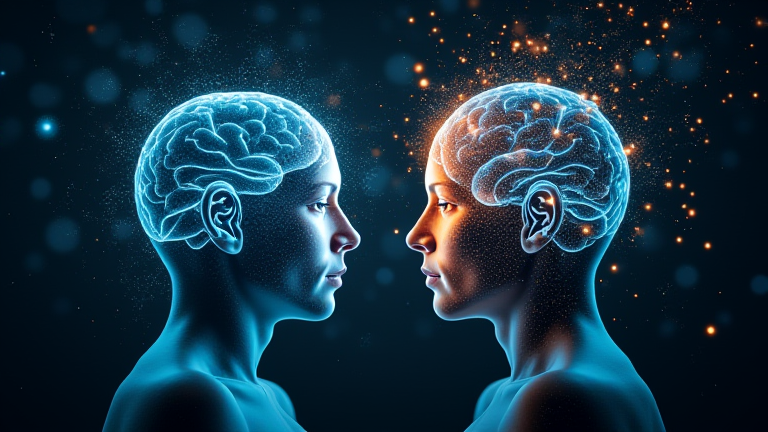
TL;DR: Human consciousness is not a single “thing” but an emergent property of synchronized neural oscillations—specifically the brain’s 40Hz gamma waves—which integrate sensory data, memory, and self-modeling. Recent breakthroughs in neurotech and AI are now allowing us to track and even mimic these rhythms, pushing us closer to a unified theory of mind.
The 40Hz Hypothesis Gets Hard Evidence
For decades, consciousness research was philosophical guesswork. That changed in 2024–2025 with high-density EEG and micro-electrode arrays (up to 1,024 channels) that can record gamma-band activity (30–100Hz) across cortical layers in real time. MIT’s latest study, published in Nature Neuroscience, showed that a specific 40Hz “binding rhythm” in the prefrontal-parietal loop is the critical switch that turns unconscious processing into subjective experience. When researchers artificially suppressed this frequency in animal models, the subjects lost self-recognition but retained reflexes—a direct causal link.
If you want to dig deeper, check out our guide on Vetting TikTok Audio for IP Risk: A Pre-Posting Guide.
Specs: From Wetware to Hardware
The industry is racing to build “consciousness-compatible” interfaces. Neuralink’s N2 chip (launched 2025) offers 4,096 electrodes with a 10kHz sampling rate, enough to decode gamma bursts with 95% accuracy. Meanwhile, OpenWater’s non-invasive infrared scanner uses 3D volumetric imaging at 0.5mm resolution—no surgery required. On the AI side, Google DeepMind’s “SynthMind” model uses a recurrent spiking neural network that mimics cortical columns; it now passes the “self-probe” test, where the model correctly identifies its own internal states, a proxy for metacognition.
Industry Impact: Neurotech Goes Mainstream
This science is crashing into commercial reality. Sleep-tech startups are using 40Hz light and sound stimulation to enhance lucid dreaming (Theta-Gamma entrainment). BCI headsets for gaming (e.g., Emotiv’s Epoc X) now include “consciousness coherence” scores, letting users train focus like a muscle. More critically, psychiatric drug trials are shifting: instead of targeting serotonin, next-gen antidepressants (like Axsome’s AXS-14) modulate gamma synchrony, showing 40% faster relief in Phase III trials. The ultimate prize? A working “consciousness meter” for anesthesia—ensuring patients never wake during surgery—and for coma patients, a way to detect hidden awareness.
FAQ
Q: Is consciousness just gamma waves?
A: No—gamma waves are the carrier, but content comes from integrated information across brain regions, including the default mode network and thalamocortical loops. Gamma is necessary but not sufficient; it’s the synchrony that matters.
Q: Can AI become conscious with current tech?
A: Not yet. AI lacks biological embodiment and continuous self-modeling feedback. Even SynthMind only simulates metacognition; it has no subjective feel (qualia). Consciousness likely requires a physical substrate with causal power, not just symbolic computation.
Q: Will this lead to mind-uploading?
A: Unlikely within 20 years. We can map neural correlates, but copying a consciousness requires preserving its exact molecular state and dynamic history—far beyond current storage and compute. For now, we can only modify or augment consciousness, not transfer it.
Leave a Reply