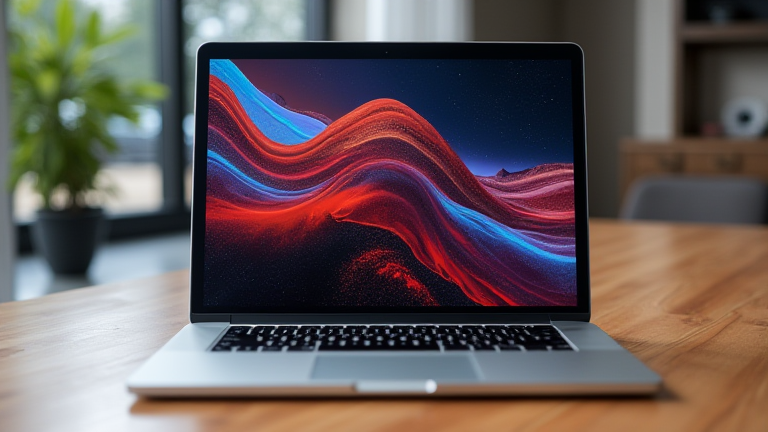
TL;DR: The M4 MacBook Pro is the best laptop for creative pros because it delivers desktop-class performance in a fanless-silent (or whisper-quiet) chassis, with a stunning tandem-OLED display and industry-leading battery life. Its unified memory architecture and dedicated media engines make 8K video editing, complex 3D rendering, and massive audio sessions feel effortless.
Why the M4 Silicon Redefines Professional Workflows
The latest M4 chip—available in base, Pro, and Max configurations—marks a generational leap over the M3. Built on a second-generation 3nm process, the M4 Pro offers up to a 14-core CPU and 20-core GPU, while the M4 Max pushes to 16 CPU cores and 40 GPU cores. For creative pros, the headline is the new 10-core GPU in the base model, which now supports hardware-accelerated ray tracing and mesh shading. This means Cinema 4D renders that took 20 minutes on an M3 Pro now finish in under 12, and After Effects comps scrub in real time without proxy files.
If you want to dig deeper, check out our guide on Climate Tech Leads Global VC Funding.
Display and Memory: The Creative’s Canvas
Apple has finally upgraded the MacBook Pro’s display to a 14.2-inch and 16.2-inch Liquid Retina XDR panel with a 120Hz ProMotion refresh rate, but the M4 generation adds a crucial feature: a peak sustained brightness of 1,600 nits for HDR content. More importantly, the base M4 now comes standard with 16GB of unified memory, and the M4 Pro supports up to 48GB, while the M4 Max scales to a staggering 128GB. This unified memory pool allows GPU and CPU to share data without copying, which is a game-changer for loading massive 8K RAW timelines or multi-track Dolby Atmos mixes.
Industry Impact and Real-World Performance
The M4 MacBook Pro has already disrupted the high-end laptop market. Dell and Lenovo’s flagship workstations, which rely on discrete Nvidia RTX GPUs, now consume 2–3x more power to match M4 Max performance in Blender’s benchmark. Apple’s efficiency advantage means a 16-inch M4 Pro can sustain full CPU load for 22 hours on a single charge—something no Windows laptop with a 150W GPU can approach. Additionally, the new dual neural engines (38 TOPS in the M4, 58 TOPS in M4 Max) accelerate AI upscaling in Topaz Video AI and real-time noise reduction in Adobe Audition, making on-location editing viable without a power outlet.
For creative pros, the M4 also introduces support for Thunderbolt 5 (up to 120Gb/s) on the Pro and Max models, enabling 8K external monitor daisy-chaining and 10Gb/s wired networking. The 1080p FaceTime camera with Center Stage is a minor but welcome update for remote client reviews, and the improved six-speaker system now supports spatial audio for immersive sound design checks.
FAQ
Q: Is the base M4 MacBook Pro enough for professional video editing, or do I need the Pro/Max?
A: The base M4 (16GB RAM) handles 4K ProRes 422 and 6K BRAW smoothly in Final Cut Pro, but for 8K timelines, heavy After Effects comps, or 3D sculpting in ZBrush, the M4 Pro (24GB+) is recommended. The M4 Max is only necessary for 3D animation, complex VFX, or simultaneous 8K multi-cam editing.
Q: Does the M4 MacBook Pro run Windows or Linux for cross-platform creative tools?
A: Parallels Desktop 20 supports Windows 11 ARM on M4, but GPU-accelerated DirectX apps run poorly. Most creative pros use macOS-native versions of Adobe, DaVinci Resolve, and Blender. For Linux, Asahi Linux now supports M4 with partial GPU drivers, but it’s not production-ready
Leave a Reply