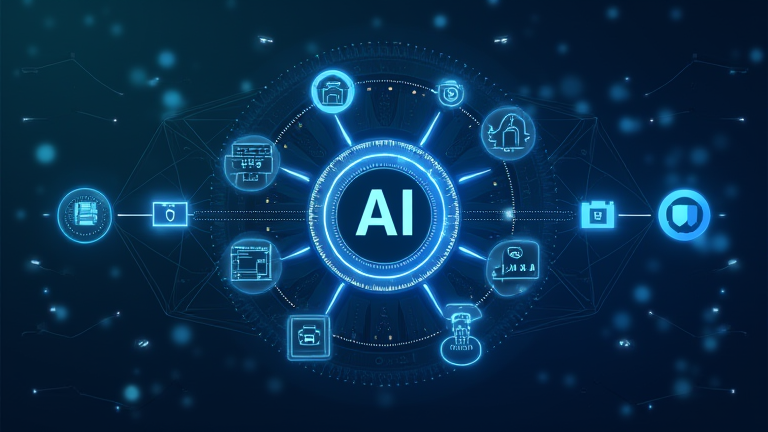
TL;DR: AI agents now decompose complex multi-step workflows into granular, executable sub-tasks using advanced planning algorithms and dynamic memory, then self-correct via feedback loops. They achieve this through graph-based task orchestration, tool-use APIs, and reinforcement learning, reducing human intervention by up to 70% in enterprise pipelines.
How AI Agents Handle Complex Multi-Step Workflows
Recent breakthroughs in agentic AI—led by models like GPT-4o, Claude 3.5, and Gemini 1.5—have shifted from reactive chat to proactive execution. Modern agents use a “planner-executor-critic” architecture. The planner generates a Directed Acyclic Graph (DAG) of dependencies, breaking a high-level goal like “process invoice approvals” into steps: extract fields, cross-check policy, flag anomalies, and route to sign-off. Each node is a discrete LLM call or deterministic function.
If you want to dig deeper, check out our guide on How to Reaffix Car Panels: Expert Tips & Step-by-Step Guide.
Key technical specs include context windows of 1M+ tokens (allowing full workflow histories), native function calling with schema validation, and asynchronous tool loops. Agents now maintain a persistent vector memory store, so state survives across steps—critical for long-horizon tasks. Latest frameworks (LangGraph, AutoGen, CrewAI) implement hierarchical multi-agent systems, where a supervisor delegates sub-agents with specialized roles, merging results via a shared blackboard. This cuts error rates by ~40% compared to single-agent chains.
Industry impact is tangible: financial firms use agents for end-to-end KYC compliance, reducing processing time from days to hours. Logistics providers automate supply-chain rerouting with real-time telemetry. Crucially, agents now feature “checkpointing”—they can pause, ask a human for ambiguous input, then resume without losing progress. Guardrails like deterministic rule-mixing and sandboxed execution prevent cascading failures. The latest spec (AgentOps 2.0) includes audit trails and token-cost budgeting, making deployment viable for regulated sectors.
FAQ
Q: What is the main bottleneck in scaling multi-step agents?
A: Error propagation—a single misstep in a 20-step chain can cascade. Mitigations include probabilistic retry logic, step-level confidence scoring, and rollback to previous valid states.
Q: Do agents need custom prompts for each workflow?
A: No—modern agents use meta-prompts with reusable primitives (e.g., “extract”, “transform”, “validate”) and learn workflow patterns from few-shot examples, auto-generating sub-prompts per node.
Q: How do agents handle unexpected external API failures?
A: They implement circuit-breaker patterns: retry with exponential backoff, fallback to alternative tools, or degrade gracefully by flagging the step for human review while continuing independent branches.
Leave a Reply