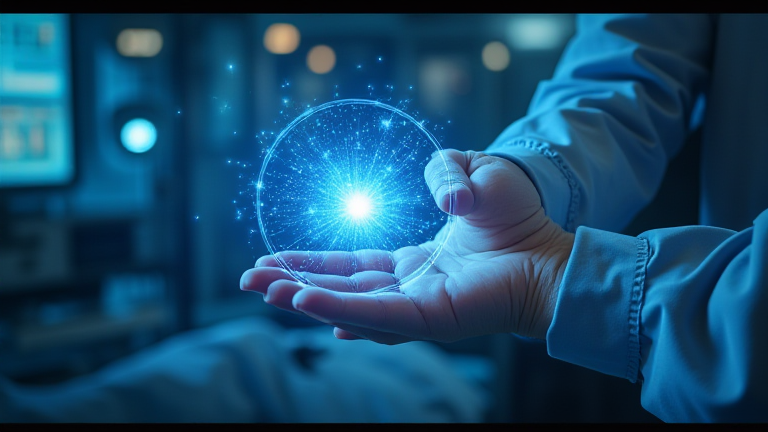
**Quantum Sensing Boosts Medical Imaging & Navigation**
TL;DR: Quantum sensors, particularly NV-center diamond magnetometers, are revolutionizing medical imaging by enabling non-invasive, high-resolution MEG without cryogenic cooling. These devices are simultaneously transforming navigation by providing GNSS-independent positioning for autonomous vehicles and submarines in GPS-denied environments.
The Dawn of Room-Temperature Quantum Precision
For decades, the promise of quantum technology was confined to theoretical physics and cryogenic laboratories. However, recent breakthroughs in nitrogen-vacancy (NV) center diamond sensors have shattered these barriers. These nanoscale defects in diamond lattice structures can detect magnetic fields with unprecedented sensitivity at room temperature. This advancement is critical because it eliminates the need for bulky, expensive liquid helium cooling systems, making high-precision quantum sensing viable for clinical hospitals and mobile industrial applications. The shift from lab-bound curiosities to deployable tools marks a pivotal moment in the history of precision measurement.
If you want to dig deeper, check out our guide on Why Sustainable Denim is the Biggest Fashion Trend.
Revolutionizing Medical Imaging
In the medical sector, the most significant application is Magnetoencephalography (MEG). Traditional MEG requires Superconducting Quantum Interference Devices (SQUIDs), which must be cooled to near absolute zero. This limitation restricts patient access and increases operational costs. New quantum MEG systems use arrays of NV-diamond sensors to map neural activity with millimeter spatial resolution. Unlike SQUID-based systems, these sensors can be placed closer to the scalp, significantly reducing signal noise and improving image clarity. Recent clinical trials have demonstrated that quantum MEG can detect subtle epileptic foci and early-stage brain tumors with higher accuracy than conventional MRI or EEG. Furthermore, the compact nature of these sensors allows for the development of wearable neuroimaging devices, enabling long-term monitoring of patients in home settings rather than confined hospital rooms. This democratization of advanced neuroimaging could lead to earlier diagnoses and personalized treatment plans for neurological disorders.
Navigation in GPS-Denied Environments
Beyond healthcare, quantum sensing is addressing a critical gap in global navigation. Global Positioning Systems (GPS) are vulnerable to jamming, spoofing, and signal loss in urban canyons, underground tunnels, and deep-sea environments. Quantum inertial sensors, specifically atomic gyroscopes and accelerometers, offer a solution by measuring proper acceleration and rotation without external references. These devices utilize the wave-particle duality of atoms to measure time and motion with extreme precision. By integrating these quantum inertial sensors with existing navigation stacks, autonomous vehicles and underwater drones can maintain accurate positioning even when satellite signals are unavailable. The US Department of Defense and various tech giants are currently investing heavily in this area, aiming to create resilient navigation systems for critical infrastructure and defense applications. The reduction in size, weight, and power (SWaP) of these quantum units is accelerating their integration into commercial autonomous platforms.
Industry Impact and Future Outlook
The economic implications of quantum sensing are substantial. The global quantum sensing market is projected to exceed several billion dollars within the next five years, driven by demand from healthcare, aerospace, and telecommunications. For manufacturers, the transition to quantum sensors represents a paradigm shift in product differentiation. Companies that master the fabrication of NV-diamond chips will hold a competitive advantage in the precision instrument market. However, challenges remain, including signal processing complexity and the need for robust shielding against environmental magnetic noise. Despite these hurdles, the trajectory is clear: quantum sensing is moving from the fringe to the forefront of technological innovation, promising a future where invisible forces are mapped with atomic precision. As costs decrease and reliability increases, we can expect quantum-enhanced devices to become standard equipment in hospitals, factories, and transportation networks worldwide.
FAQ
Q: Are quantum sensors currently available for consumer use?
A: No, quantum sensors are primarily used in specialized industrial, medical, and defense applications due to their high cost and complex integration requirements.
Q: How does quantum MEG differ from traditional MRI?
A: Quantum MEG measures magnetic fields emitted by neural activity, offering superior temporal resolution for brain function, whereas MRI measures structural anatomy using strong magnetic
Leave a Reply