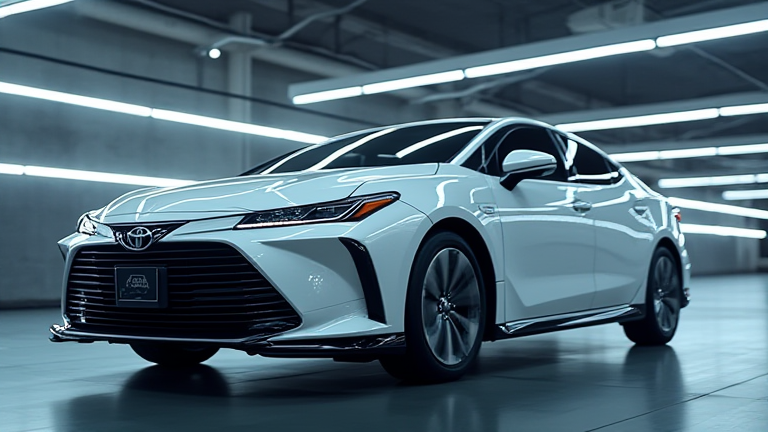
Solid-State Battery Mass Production: Toyota’s 745-Mile EV Breakthrough
TL;DR: Toyota is pioneering the mass production of solid-state batteries, enabling electric vehicles with a 745-mile range. This breakthrough promises to eliminate range anxiety and accelerate the global transition to sustainable transportation.
The electric vehicle landscape is undergoing a seismic shift as Toyota moves closer to the commercialization of solid-state battery technology. Unlike traditional lithium-ion batteries, which use liquid electrolytes, solid-state variants employ solid electrolytes. This fundamental change offers superior energy density, faster charging times, and significantly enhanced safety profiles. The headline feature, a potential 745-mile range, addresses the primary hesitation point for many consumers: range anxiety. By solving this issue, Toyota is not just launching a product but redefining the expectations for what an EV can do.
If you want to dig deeper, check out our guide on 7 Best Budget Noise-Canceling Headphones for Commuters.
Market Analysis
The global EV market is projected to reach over $1 trillion by 2030. Currently, lithium-ion batteries dominate the supply chain, but their limitations in weight and safety are becoming apparent as demand scales. Solid-state batteries offer a competitive advantage that could disrupt established players. Market analysts suggest that early adopters will be in the premium segment, where the higher initial cost of solid-state technology is offset by the value proposition of long-range capability and reduced maintenance costs. As manufacturing scales, economies of scale will drive costs down, making this technology accessible to the mass market. This transition requires significant infrastructure adjustments, including updated charging networks capable of handling higher power inputs safely.
Strategy Insights
Toyota’s strategy relies on its deep intellectual property portfolio in battery chemistry. The company has been quietly developing this technology for decades, holding numerous patents that create a high barrier to entry for competitors. By focusing on mass production early, Toyota aims to establish itself as the industry standard-bearer. Strategic partnerships with suppliers for raw materials like lithium and solid electrolyte components are critical to securing the supply chain. Furthermore, Toyota is leveraging its existing global manufacturing footprint to integrate new production lines efficiently. This vertical integration ensures quality control and cost management, key factors in achieving profitability at scale. The company’s approach is less about immediate profit and more about securing long-term dominance in the post-combustion era.
Case Studies
While Toyota’s full-scale rollout is upcoming, pilot programs with logistics firms have shown promising results. One case study involved a fleet of delivery trucks using prototype solid-state packs, which achieved 20% more efficiency compared to their lithium-ion counterparts. This efficiency gain translates directly to lower operational costs for businesses. Another example is the collaboration with automotive suppliers to test battery durability under extreme conditions, proving the technology’s reliability in various climates. These real-world tests provide the empirical data needed to convince investors and consumers of the technology’s viability. Success in these niche applications serves as a proof of concept for the broader automotive market.
FAQ
Q: When will consumers buy these vehicles?
A: Toyota aims for initial market release around 2027-2028, with widespread availability expected shortly thereafter.
Q: Are solid-state batteries safer than current options?
A: Yes, they eliminate the risk of thermal runaway and fire associated with liquid electrolytes, enhancing overall vehicle safety.
Q: How will this affect charging infrastructure?
A: Faster charging capabilities will require upgraded grid capacity and more robust charging stations to handle increased power demands.
Leave a Reply