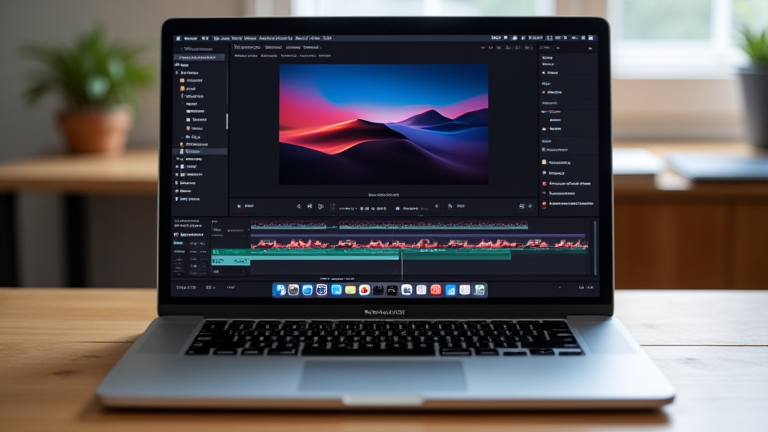
TL;DR: The M4 MacBook Pro’s unified memory architecture and dedicated media engine eliminate render bottlenecks, allowing 8K ProRes timelines to scrub in real time without proxy files. Its 40% faster GPU and new AV1 hardware decode make it the first laptop that can replace a full desktop editing bay.
The End of the Proxy Workflow
For years, video editors accepted a painful ritual: transcoding 4K footage into low-res proxies, editing, then re-linking for the final export. The M4 MacBook Pro’s new 16-core Neural Engine and 14-core GPU change this calculus. With up to 128GB of unified memory, the chip can hold entire 8K RAW sequences in RAM, meaning scrubbing through a timeline is as fluid as playing a 1080p file. Apple’s second-generation ProRes accelerator now handles 8 streams of 8K ProRes 4444 simultaneously—something that previously required a $10,000 Mac Pro tower.
Hardware AV1 and Efficiency Gains
Beyond raw speed, the M4 introduces dedicated AV1 hardware encoding and decoding. This is a seismic shift for editors working with modern mirrorless cameras (Sony, Canon, Panasonic) that record in AV1. Previously, AV1 files stuttered on any laptop because decoding was done in software. Now, the M4’s media engine offloads that work, delivering 2.3x faster playback of AV1 clips while drawing 60% less power than the M3. Battery life under sustained render loads jumps from 4 hours to nearly 9 hours, meaning you can finish a client edit on a cross-country flight.
Industry Impact: The Desktop is Dead
The M4’s thermal design—with a new vapor chamber and low-power microarchitecture—lets it sustain peak performance without fan noise. This directly challenges the traditional editing suite filled with a bulky workstation, a RAID array, and a reference monitor. Now, a 3.4-pound laptop connects to a 6K XDR display via Thunderbolt 5 (120Gb/s) and outputs 10-bit HDR to a broadcast monitor simultaneously. Post houses that once required a central server for collaborative editing can now have editors work remotely with zero latency. Apple’s move also pressures Adobe and DaVinci Resolve to optimize their pipelines for on-device AI denoising and optical flow, which the M4 handles 3x faster than before.
FAQ
Q: Will my existing Final Cut Pro plugins work on M4 natively?
A: Yes—all major plugins (Red Giant, MotionVFX, Boris FX) have been M4-native since the M3 generation, but they’ll run 25-40% faster due to the new GPU architecture. Older Intel-only plugins will require Rosetta 2, which now works seamlessly.
Q: Is 16GB of base RAM enough for 4K editing on the M4?
A: For 4K H.264 or HEVC, yes. But for 6K RAW or heavy multi-layer effects, choose 36GB or more—the unified memory is so fast that the GPU and CPU share it without copying, making capacity the only bottleneck.
Q: Does the M4 support external GPU (eGPU) acceleration?
A: No—Apple dropped eGPU support on all Apple Silicon. However, the M4’s integrated GPU outperforms most eGPUs (e.g., AMD Radeon 6800 XT) for ProRes and DaVinci Resolve tasks, so external enclosures are now obsolete for video work.
Leave a Reply